We write the nexus letter. Your doctor reviews and signs it.
Upload your records and we build a full drafted letter — the diagnosis, the service link, the VA’s “at least as likely as not” standard, and the reasoning behind it, argued from PubMed and NIH literature and cited line by line. Your clinician gets something to correct and sign, not a blank page.
Already analyzed your C-File with us? We pull decades of dates, exams and entries straight into the draft — start there instead.
AI-powered self-help software for veterans filing their own VA claims. You operate it, you decide, you file — and nobody takes a cut of your benefits.
- 30,000+ veterans
- Veteran owned and built
- Your records never sold
I am a board-certified physician in orthopedic medicine…
I reviewed the service treatment records and current imaging…
The veteran has a current diagnosis of lumbosacral strain.
…it is at least as likely as not related to service.
This opinion is based on the following rationale…
- Drafted for your clinician to confirm in their own words.
- We list every record we read, cited by date and page.
- Pulled from your own records, in clinical terms.
- The VA's own probability standard, worded exactly.
- The argument — built from PubMed and NIH literature.
The bridge between service and a diagnosis.
Service connection rests on three links: something that happened in service, a current diagnosis, and a medical link between them. That third link is the nexus — and unlike the other two, it can’t come from records alone. It takes an argument, made in writing, that a clinician is willing to sign.
A nexus letter is that opinion. It’s a short document from a doctor, nurse practitioner, psychologist or other qualified provider saying, in their professional judgment, whether your condition is connected to your service — and why they think so.
The letter isn’t magic and it isn’t a form. Its weight comes entirely from the reasoning inside it — which is the part we do, and the reason we build the argument out of published medical research rather than a template.
- 01 · Service event
- 02 · Diagnosis
- 03 · Nexus
- Who drafts it
- We do — from your records and the published literature, with the source behind every line.
- Who signs it
- A qualified clinician — your own doctor, a VA provider, or a specialist. The signature is what makes it an opinion.
- When it matters
- Most often when a decision letter says the evidence didn't connect a diagnosed condition to service.
- When it may not
- Some conditions are presumptive — the link is assumed. Worth checking before you ask anyone for one.
Five things a nexus opinion has to address.
Understanding these is the difference between an appointment that goes somewhere and one that doesn’t. Your clinician decides what they can say — you just shouldn’t be hearing these terms for the first time in the room.
- 01
Who is writing it
Their credentials, specialty, and why they're qualified to speak to this condition. An opinion carries the weight of the person holding it.
- 02
What they reviewed
Service treatment records, current medical records, exam results, your own account. An opinion formed from nothing reads like one.
- 03
The current diagnosis
Named in clinical terms, as it stands today. Symptoms described in everyday words aren't the same thing as a diagnosis.
- 04
The standard, in the VA's words
“At least as likely as not.” It's the phrase the VA works in — and it means something specific, which is why it's worth understanding before the appointment.
- 05
The rationale
The reasoning: what in the medicine and the record leads them there. This is the part reviewers read closest — a conclusion without it is just an assertion.
A real draft, for a real denial.
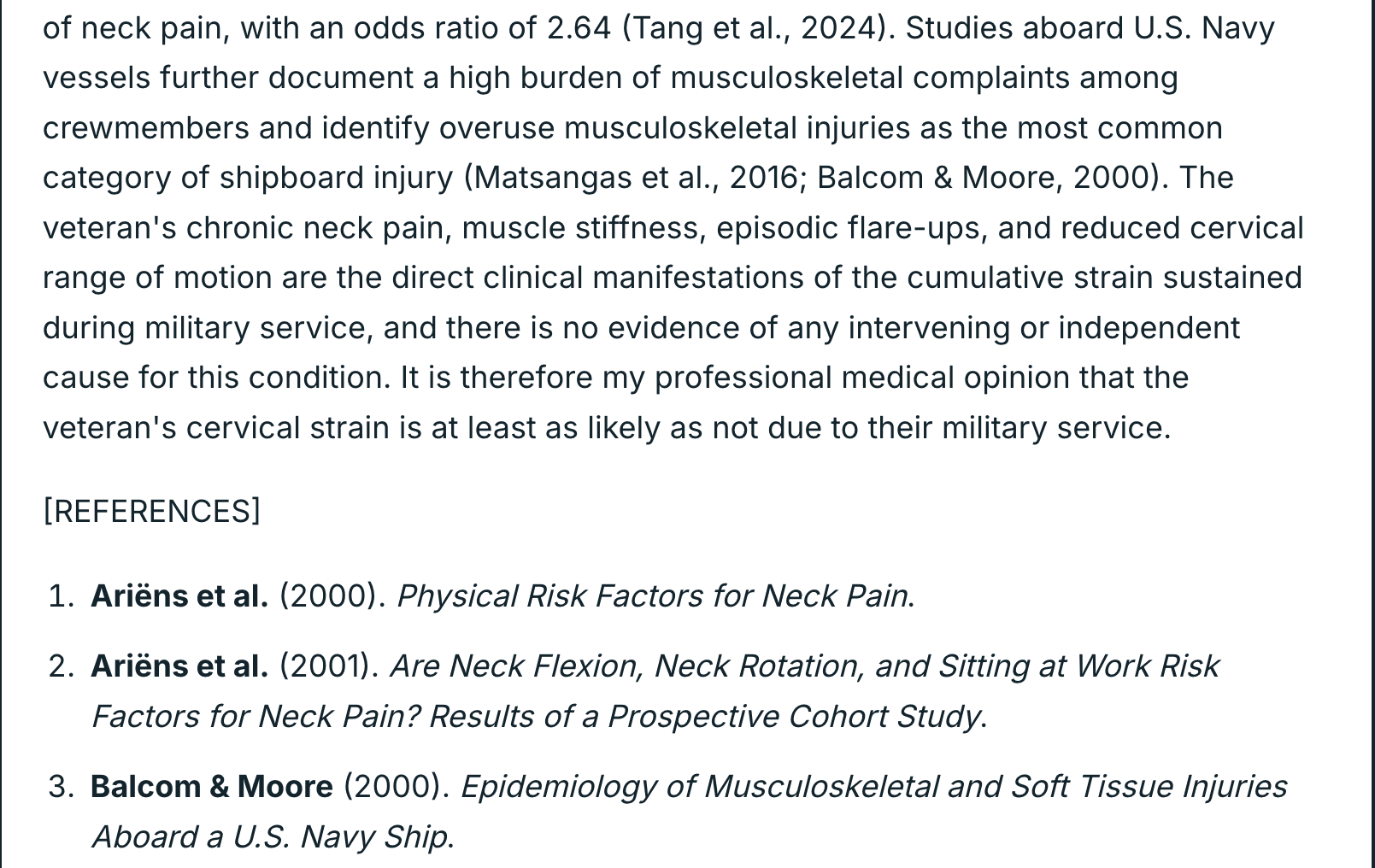
A cervical strain denied for a missing nexus. The draft argues the link from studies of neck pain in service members and closes on the standard the VA applies, for the veteran's own clinician to review, edit and sign.
Nexus letter
Draft… It is therefore my professional medical opinion that the veteran's cervical strain is at least as likely as not due to their military service.
References
- Ariëns et al. (2000). Physical Risk Factors for Neck Pain.
- Balcom & Moore (2000). Epidemiology of Musculoskeletal and Soft Tissue Injuries Aboard a U.S. Navy Ship.
- Tang et al. (2024). Prevalence and Related Factors for Neck Pain in Military Personnel: A Systematic Review.
Three of the draft’s six references.
“At least as likely as not” is a 50/50, not a certainty.
It’s the phrase that trips up veterans and clinicians alike. It does not mean proven. It does not mean beyond doubt. It means the evidence is at least evenly balanced — a 50% probability or better — and when it’s evenly balanced, the benefit of the doubt goes to the veteran.
Plenty of good opinions get less weight than they should because they were written in ordinary language — “possibly related”, “could be connected” — that doesn’t map onto the standard the VA works in.
Six, our AI reference tool, can walk you through what the phrase means and how the terms around it fit together — any time, including the night before an appointment.
- “Less likely than not” — below the line. Under 50%.
- “At least as likely as not” — meets the line. The VA's own wording.
- “More likely than not” — above the line. Also clears it.
You upload. We draft. Your doctor signs.
Three steps, and the one in the middle is the one that usually costs a veteran weeks of waiting or a four-figure fee.
- 01
- Service treatment records
- C-File analysis
- Decision letter
Upload what you have
Service treatment records, private notes, a decision letter — whatever you hold. We read them and pull out what actually bears on the link between your condition and your service.
- 02PUBMEDNIH
We draft the argument
A complete letter, not a template: your diagnosis, the service event, the VA's “at least as likely as not” standard, and a rationale argued from PubMed and NIH literature — with the citation behind every line.
- 03
- Verify · Change · Strike
- Then sign, in their own words
Your clinician reviews and signs
It arrives with explicit instructions for your provider on what to verify, what to change and what to strike. They edit it to match what they actually believe, and they sign — which is what makes it a medical opinion.
A draft is not an opinion until a clinician signs it, and they decide whether they can. We never send it anywhere, and no letter goes to the VA without your provider putting their name on it. Accredited VSOs help for free and can talk this through with you too — find one through the VA.gov accreditation search.
We can’t be a medical opinion. We can save your doctor days of work.
The reading, the research and the drafting are hours your provider usually has to find between appointments — which is why so many decline. We do all of that from the records you upload and the published literature, then hand your clinician a finished letter to review, correct and decide on.
- Reads the records you upload — appointments, treatment notes, exam results — and pulls out what's relevant
- Writes the full letter: diagnosis, service link, the VA's standard, and the rationale behind the conclusion
- Argues it from published medical research — PubMed and NIH literature — with the citation behind every line
- Includes explicit instructions for your clinician: what to verify, what to change, what to strike
- Hold the medical judgment — a draft is only an opinion once a clinician reviews it, edits it and signs it
- Represent you, or contact the VA on your behalf
- Tell you what to claim or which review option to take
- Take a percentage of your benefits — the price is flat, always
“Had been sitting at 30% for almost a decade because I didn't think I could claim anything else. I used VeteranAI to identify secondary conditions I didn't even realize were connected. Filed for three secondaries with nexus letters generated through the platform and was granted all three. 30% to 80% just like that.”
30% to 80% in one filing
“Used VeteranAI to file for an increase on 1 condition and generated statements and nexus letters for 2 additional conditions. Fully granted on all submissions, achieving 100% P&T status in less than 2 months start to finish.”
100% P&T in under 2 months
Reviews are from verified account holders. Outcomes depend on your own records and your own clinician's judgment. Read more reviews
Analyze your C-File first. The draft gets far better.
Sick call visits, exposure records, the exam a rater relied on — it’s all in your Claims File, and a clinician forming an opinion will want to see it. A draft built from a handful of uploads can only reference a handful of uploads.
Run the C-File through the analyzer first and we can cite the actual dates, entries and documents across decades of records — so what reaches your provider is specific and sourced instead of general. If you’ve had a decision letter, that letter also says in the VA’s own words what it found the record was missing.
Medical history is about as private as data gets.
Anything you upload is encrypted, visible only to you, never sold, and never used to train models. Delete your account and it goes with it.
- Encrypted at rest and in transit
- Never sold — to anyone, ever
- Never used to train our models
- Delete your account and every page goes with it
One price. Try it before you pay.
No plan-picking at signup — every account starts the same way, with full access to the whole toolkit. See all plans →
- Full drafted nexus letters, argued from PubMed and NIH literature
- A citation behind every line, plus review instructions for your clinician
- C-File and decision letter analysis — the more we read, the more specific the draft
- Six, the AI reference tool, 24/7 all year
Draft a full letter before you’re charged anything. $25/month afterward if you stay monthly.
- Full access for those 17 days
- Cancel in two clicks — no contract, no collections
Straight answers
A nexus letter is a written medical opinion from a qualified clinician addressing whether a current, diagnosed condition is connected to something that happened during service. It typically states the clinician's credentials, what records they reviewed, the diagnosis, their conclusion in the VA's “at least as likely as not” language, and the reasoning behind it.
We draft it; a qualified medical professional signs it. That's your own physician, a VA provider, a specialist, a nurse practitioner or a psychologist, depending on the condition — someone with the standing to hold a medical opinion, because the signature is what makes the document one. They can change anything in the draft, and what they sign is theirs.
No. Some conditions are presumptive, meaning the VA assumes the connection based on where and when you served. In other cases the link is already documented in your service records, or a VA examiner addresses it directly. A nexus opinion comes up most often when a decision letter says the connection between service and diagnosis wasn't established. What applies to your situation is a question for an accredited representative or your clinician.
It's the VA's evidentiary standard: a probability of 50% or greater. It doesn't mean certainty or proof — it means the evidence is at least evenly balanced, and where it is, the benefit of the doubt goes to the veteran. It's why the exact wording of a medical opinion matters: “possibly related” doesn't say the same thing.
Yes, and it's one of the most common reasons veterans need one. A secondary condition is a disability caused or worsened by an already service-connected condition — sleep apnea secondary to PTSD, or hip problems secondary to a service-connected knee injury. The opinion addresses the link between the two conditions rather than between service and a condition directly, but it has to clear the same standard and carry the same reasoning.
Yes. We write a complete draft from the records you upload — the diagnosis, the service link, the VA's “at least as likely as not” standard, and a rationale argued from PubMed and NIH medical literature, with the citation behind every line and explicit instructions for your provider on what to verify, change or strike. What we can't do is hold the medical judgment: a draft is only a nexus opinion once a qualified clinician has reviewed it, edited it to match what they actually believe, and signed it. Your doctor decides; we save them the hours of reading, research and assembly.
Yes. We publish free templates for PTSD, migraines and lumbar strain that show how an opinion is normally structured — credentials, records reviewed, diagnosis, the standard, the rationale. A template is a blank shape you still have to fill in yourself; the drafted letter is the paid product, written from your actual records and cited to the literature.
Two things: your own records, and published medical research. We cite the dates, exams and entries from the records you upload, then build the rationale on peer-reviewed literature indexed in PubMed and NIH databases — the same sources a clinician would reach for. Every claim in the letter carries its source, so your provider can check the reasoning rather than take it on faith. Where the literature doesn't support a link, we say so instead of inventing one.
No. VeteranAI is self-help software you operate on your own records. We are not accredited, we don't represent you, we never contact the VA or touch VA systems on your behalf, and we charge a flat subscription — never a percentage of your benefits. Only a VA-accredited representative, agent or attorney can represent you, and accredited VSOs do it free.
A 17-day free trial, then $25/month or $250 a year for the whole toolkit. No percentage of your back pay, ever — nobody here is paid out of your award. Any fee your own clinician charges for their time is between you and them.
Walk into that appointment with the letter already written.
Upload your records tonight and we’ll draft the argument — cited, sourced from the medical literature, and ready for your doctor to review and sign.
Draft my nexus letterFree for 17 days · $250 / year after · no cut of your back pay