Your decision letter explains itself. Just not in English.
Upload the letter the VA sent you and we translate it back to the three things every claim rests on — service event, diagnosis, nexus — condition by condition. You see which of the three the VA accepted, which one it says was missing, and what that link actually means, in the VA’s own words, translated.
AI-powered self-help software for veterans filing their own VA claims. You operate it, you decide, you file — and nobody takes a cut of your benefits.
- 30,000+ veterans served
- Veteran owned and built
- Your records never sold
- Service connection for lumbosacral strain is denied.
- …not related by a preponderance of the evidence.
- Evaluation of tinnitus is continued as 10 percent disabling.
- The issue of sleep apnea is deferred.
- Your back claim was turned down — the VA didn’t accept that it started in service.
- The VA weighed both sides and decided the evidence tipped against you — not that you have no evidence.
- Your tinnitus stays at 10% — that is the highest rating the schedule allows for tinnitus.
- Not decided yet. The VA is waiting on something — usually a C&P exam or a records request.
Every VA decision comes down to three things.
Service connection is a chain of three links. Break one and the claim is denied — no matter how strong the other two are. Your letter says which link broke. It just doesn’t say it in those words.
This is what a typical denial looks like: two links accepted, one missing. The letter spends four paragraphs saying it.
- 01
Service event
Something happened in service: an injury, an illness, an exposure, a stressor. It’s in your service records, or a buddy statement puts it there.
In the letter: “the evidence does not show an event, injury or disease in service” - 02
Diagnosis
A current, diagnosed condition — today, not a decade ago. Symptoms alone aren’t enough; the VA needs a clinician’s name on it.
In the letter: “a current diagnosis of the claimed condition is not shown” - 03
Nexus
The medical link between the two — a clinician saying the condition is at least as likely as not related to the service event. This is the link that breaks most often.
In the letter: “not related by a preponderance of the evidence”
The VA already told you why. In code.
A rating decision is the VA’s written answer on every condition you claimed: granted, denied, deferred, or continued at the same percentage — plus the reasons and bases section that explains the call, in regulation language.
Most veterans read the first page, see a number, and never get to the part that says which piece of evidence was missing. That part is the whole letter.
- Granted
- Service connected. A percentage and an effective date follow.
- Denied
- One of three links failed: diagnosis, in-service event, or the nexus between them.
- Deferred
- Not decided. Usually waiting on an exam or records — no action needed yet.
Every issue, decoded
Each claimed condition pulled out of the letter with its outcome, percentage, effective date and the VA’s stated reason — in ordinary words.
The gap the VA named
Denials almost always point at one missing link. We surface which one — nexus opinion, current severity, in-service event — so you know what the record lacked.
Six answers the follow-ups
Six is an AI reference tool for looking up how VA claims work. Ask what a term in your letter means, how a rating criterion works, or what a review option involves — 24/7, in plain language. Six explains the rules; you decide what to do with them.
Three steps. Minutes, not an afternoon.
Don’t have the PDF? It’s in your VA.gov account under Claim Letters — we show you exactly where.
- 01Decision-Letter.pdf · uploaded
Upload the letter
The PDF from VA.gov, or a photo of the paper copy. Encrypted the moment it lands.
- 02
We read the reasons
Including the reasons and bases pages most people skip — where the actual explanation lives.
- 03
- ¶ 4
- ¶ 9
- ¶ 12
Read it in plain English
A breakdown by condition, each line linked to the paragraph it came from — and Six on hand for anything still unclear.
What your letter looks like, translated.
An example breakdown of a three-issue decision — the same content you get in the app.
- deniedLumbosacral strain
- Service event
- Diagnosis
- Nexus · missing
The letter says your back condition is diagnosed and your service records show the 2011 injury — but no medical opinion connects the two. Nexus is the broken link.
Cited: ¶ 4, ¶ 5 · pages 3–4 - grantedTinnitus · 10%
- Service event
- Diagnosis
- Nexus
All three links accepted. Effective 14 March 2025 — the date the VA received your claim. 10% is the maximum the rating schedule allows for tinnitus.
Cited: ¶ 9 · page 6 - deferredSleep apnea
- Service event
- Diagnosis · pending exam
- Nexus · not yet reached
Not decided. The letter says a VA examination is still being scheduled, so this issue stays open — nothing is required from you unless the VA asks.
Cited: ¶ 12 · page 8
A real denial, and the plan that came back.
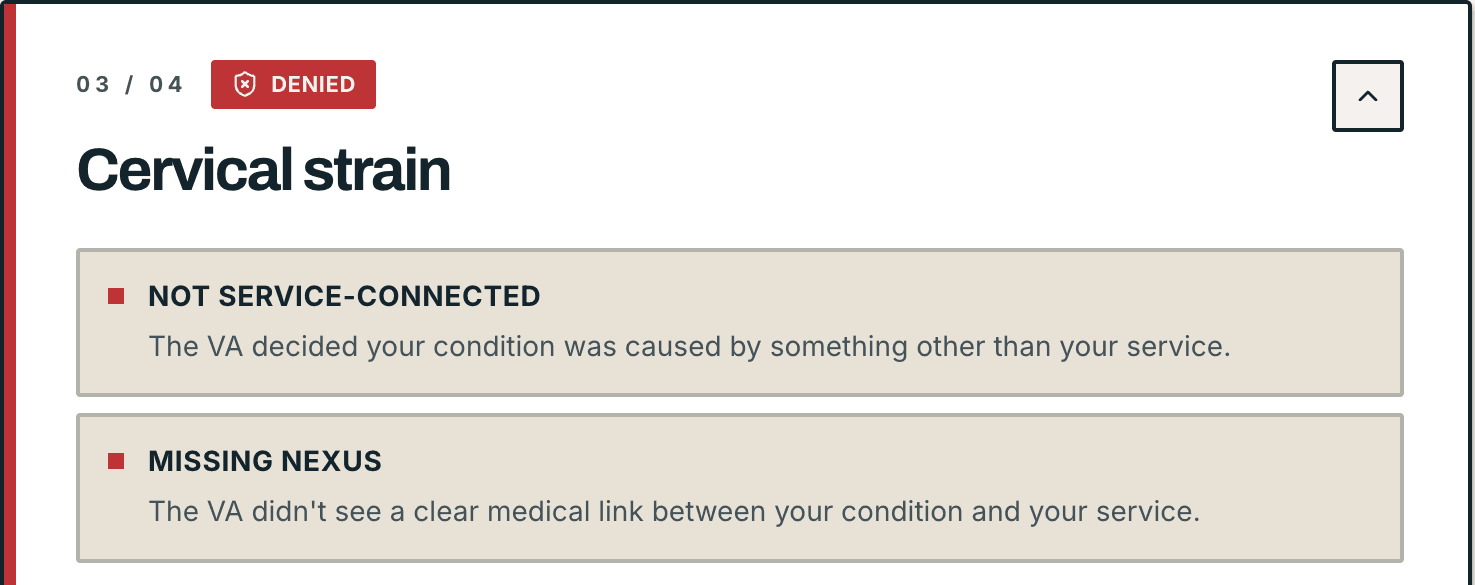
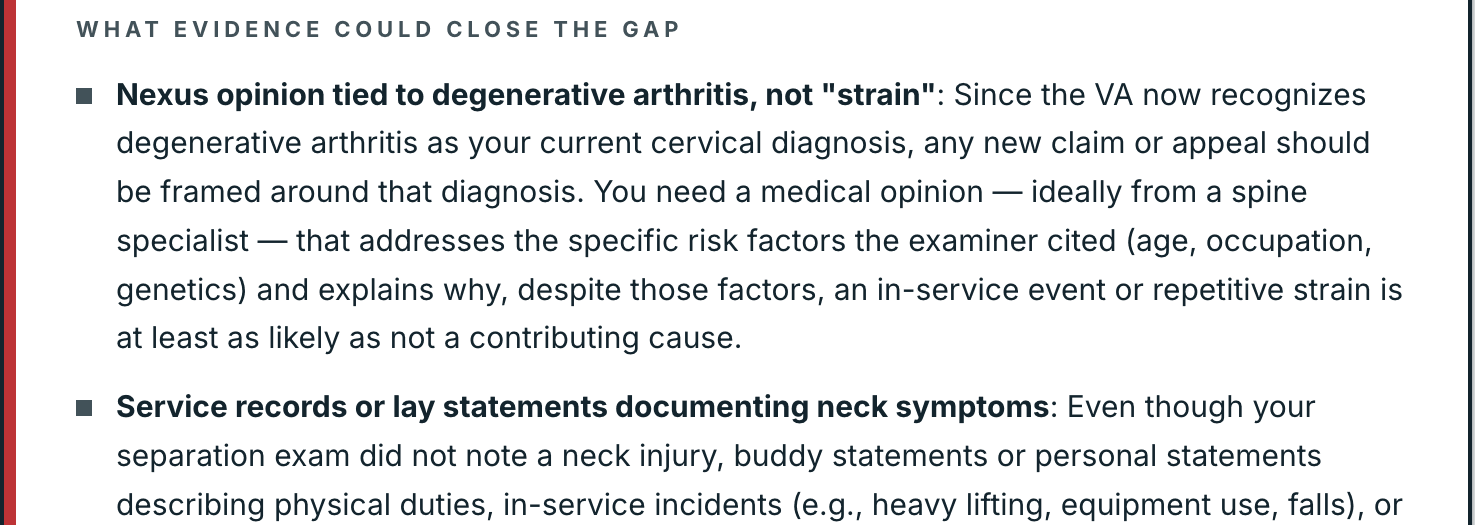
Cervical strain, denied as not service-connected with a missing nexus. The analyzer says why, and lists the evidence that would close the gap.
Your action plan
4 denials to tackle
03 / 04Denied
Cervical strain
- Not service-connectedThe VA decided your condition was caused by something other than your service.
- Missing nexusThe VA didn't see a clear medical link between your condition and your service.
What evidence could close the gap
- Nexus opinion tied to degenerative arthritis, not "strain" You need a medical opinion — ideally from a spine specialist — that addresses the specific risk factors the examiner cited …
- Service records or lay statements documenting neck symptoms buddy statements or personal statements describing physical duties, in-service incidents (e.g., heavy lifting, equipment use, falls) …
A missing link is a to-do, not a dead end.
Once you know which of the three links the letter says is missing, the work in front of you is short and specific. Here’s the list for the denied back condition above.
- Read the exam the VA relied onYour letter names the C&P examiner’s opinion. That paragraph is the whole denial — we pull it out and translate it.10 minutes
- See what your own record already holdsThe letter names the records the VA reviewed and the years it looked at. Reading your own C-File shows you what was already in there — and what the VA never saw.A week or two
- Understand what a nexus opinion needs to containThe “at least as likely as not” standard, who can write one — a clinician, not software — and what it has to reference. Learn it here, then take the question to your own doctor.20 minutes
- Take the list to an accredited VSOWalk in knowing which link is missing and what you’ve collected. Their help is free, and the conversation takes a fraction of the time.One appointment
Your review options, explained — not chosen for you.
The VA gives you three review lanes after a decision. Use VeteranAI to look up what each one is and decide which path makes sense for you.
- Option one
Supplemental Claim
For when there’s new and relevant evidence the VA hasn’t seen — a nexus opinion, newer treatment records, a buddy statement.
Generally within one year of the decision date - Option two
Higher-Level Review
A senior reviewer takes a fresh look at the same evidence. No new evidence is allowed — it’s for when you believe the existing record was misread.
Generally within one year of the decision date - Option three
Board Appeal
Review by a Veterans Law Judge at the Board of Veterans’ Appeals, with three docket lanes to choose from. The longest route, and the most formal.
Generally within one year of the decision date
VeteranAI explains what each option is and what your letter says. We’re not accredited, we don’t recommend a path, and we never contact the VA on your behalf — you file, you decide. A flat subscription, never a percentage of your benefits. Accredited VSOs help for free — find one through the VA.gov accreditation search.
“Used VeteranAI to file for an increase on 1 condition and generated statements and nexus letters for 2 additional conditions. Fully granted on all submissions, achieving 100% P&T status in less than 2 months start to finish.”
100% P&T in under 2 months
“As an 81-year-old veteran, I run into many who are not able to navigate the VA system and deal with the bureaucracy to generate a claim. Your program can be a huge help, especially for those who are not computer literate.”
U.S. veteran, lifetime member
Reviews are from verified account holders. Read more reviews
Your decision letter has your whole medical history in it.
Diagnoses, exam findings, your file number. We treat it accordingly: encrypted, visible only to you, never sold, never used to train models. Delete your account and it goes with it.
- Encrypted at rest and in transit
- Visible only to you — no rep, no broker, no buyer
- Never used to train our models
- Delete your account and every page goes with it
Your decision letter is the summary. Your C-File is the evidence behind it.
The letter tells you what the VA concluded. Your Claims File — often thousands of pages — is what it concluded it from. If the letter says evidence was missing, the C-File is where you find out whether it was actually there all along.
See the C-File Analyzer →One price. Try it before you pay.
No plan-picking at signup — every account starts the same way, with full access.
Going it alone
Free, but you’re decoding regulation language on your own — and most veterans never find the sentence that names the missing link.
Cost: your timeClaim sharks
Unaccredited, unaccountable, and paid off a cut of what you were owed all along. The “free consultation” turns into a bill of thousands — or a multiple of your monthly increase.
Cost: thousands, off your back payVeteranAI
Your letter translated tonight, the missing link named, the task list written. Works alongside your accredited VSO — never instead of one.
Cost: $0–$25 / month
- Unlimited decision letter analyses
- C-File analysis included — 10,000 pages
- Nexus letters, personal statements, buddy letters
- Full access to Six, 24/7 — all year
Upload your letter and read the full analysis before you’re charged anything. $25/month afterward if you stay monthly.
- The full decision letter analysis for those 17 days
- Cancel in two clicks, keep what you read
Straight answers
A VA decision letter is the official document the VA sends after reviewing your disability claim. It lists every condition you claimed, whether each was granted, denied, or deferred, the rating percentage for granted conditions, and the reasons behind each decision.
You can access your decision letters through VA.gov, your eBenefits account, or by contacting your regional VA office. Decision letters are typically mailed to you and also available digitally within a few days of a decision.
A deferred condition means the VA needs more information before making a decision. This could mean they're scheduling a C&P exam, requesting additional medical records, or waiting for evidence from another source. Deferred items are not denied — they're still pending.
You have three options: file a Supplemental Claim with new and relevant evidence the VA hasn't seen, request a Higher-Level Review if you believe the VA made an error with existing evidence, or appeal to the Board of Veterans' Appeals. Use VeteranAI to look up information about each review option and decide which path makes sense for you.
A Supplemental Claim is for submitting new evidence the VA hasn't reviewed — like a new nexus letter, buddy statement, or medical record. A Higher-Level Review asks a senior reviewer to re-examine the same evidence for errors. Choose supplemental when you have new evidence; choose HLR when you believe the original decision was wrong.
You generally have one year from the date of your decision letter to file a Supplemental Claim or request a Higher-Level Review. For Board appeals, the deadline is also one year. Missing these deadlines can affect your effective date, so it's important to act promptly.
No. VeteranAI is self-help software you operate on your own records: it explains what your letter says and what the VA's review options are. We are not accredited, we don't advise you on which option to take, we never contact the VA on your behalf, and we charge a flat subscription — never a percentage of your benefits or your back pay. Only a VA-accredited representative, agent or attorney can represent you, and accredited VSOs do it free.
Yes. We use industry-standard encryption to protect your data, in transit and at rest. Your letter is only used to generate your analysis, is never sold or shared with third parties, and is never used to train models. You can delete your data at any time from your account.
Find out what your letter actually says.
Upload it, read it in plain English, and decide what you want to do next — on your own terms.
Analyze my letterFree for 17 days · $250 / year after · no cut of your back pay