Your records hold the diagnosis. Only you can describe the day.
A personal statement is your own written account of how a condition affects your daily life. VeteranAI walks you through it question by question, in your words — and you read, edit and sign every line before you download anything.
Self-help software for veterans filing their own VA claims. You operate it, you decide, you file — and nobody takes a cut of your benefits.
- No doctor’s signature needed
- Veteran owned and built
- Your records never sold
- How many nights a week does the pain wake you?
- Is there something you used to do and stopped?
- How does a bad day change your work?
- What treatment are you on, and what does it cost you?
- When did it change, and how?
- “Three or four nights a week I wake around 2 a.m. and don’t get back to sleep.”
- “I stopped coaching my son’s team in 2023 — I couldn’t stand through a full practice.”
- “Nine sick days this year for flare-ups. My supervisor moved me off the loading dock in March.”
- “Meloxicam every morning. It takes the edge off but leaves me foggy until lunch.”
- “It was manageable until about 2021. Since then the bad days outnumber the good ones.”
The one piece of evidence only you can write.
A personal statement — formally a Statement in Support of Claim, VA Form 21-4138 — is your own written account of how a condition affects your daily life: work, sleep, movement, mood, relationships, the things you’ve stopped doing.
Unlike a nexus letter, it doesn’t need a clinician’s signature. It’s a firsthand account, so it comes from you and you alone.
- Your medical recordsA diagnosis, a date, an exam finding. What a clinician measured on the day you were in the room.
- Your personal statementThe other 364 days. How often, how bad, what it stops you doing, and how that has changed over time.
When veterans write one
Personal statements come up across most claim types. Which one applies to you is your call — here’s what each situation looks like.
Initial claims
Describing the day-to-day impact of a condition for the first time.
Rating increases
Documenting how a condition has changed since the last time it was rated.
Supplemental claims
Where you’re adding evidence the VA hasn’t seen after a decision.
Secondary conditions
Describing how one condition has affected another over time.
PTSD and MST claims
Where VA Form 21-0781 asks about the event itself — at your own pace, in your own detail.
21-4138, 21-0781, and the one that retired.
Both forms are free from VA.gov. What people find hard isn’t the form — it’s the blank box in the middle of it.
- VA FORM 21-4138
Statement in Support of Claim
The general-purpose personal statement. One page, mostly blank, where you describe in your own words how a condition affects your life. No clinician signature required.
Used for: initial claims, increases, supplementals, secondariesForm guide: 21-4138 → - VA FORM 21-0781
Statement in Support of Claim for PTSD
Asks about the stressful event itself — where, when, what happened, what unit you were with. It’s a hard form to sit down with. You set the pace, and you decide what goes in it.
Covers combat and non-combat stressors, fear of hostile activity, MST, personal assault, harassmentForm guide: 21-0781 → - VA FORM 21-0781a
Retired
The separate personal-assault form no longer exists. Everything it covered — including MST — now lives on the single 21-0781. If a guide you’re reading still names the 21-0781a, that guide is out of date.
One form now, for all traumatic-event claims — the 21-0781
Questions, not a blank page.
Most people don’t get stuck because they have nothing to say. They get stuck because “describe how your condition affects you” is an impossible question to answer cold.
- 01Lumbosacral strainArmy · 2008–2016
Name the condition
The condition you’re writing about and the basics of your service. No medical vocabulary required.
- 02“How many nights a week does it wake you?”
Answer in your own words
Specific, ordinary questions about sleep, work, movement, mood and the things you’ve given up. Skip any you’d rather not answer.
- 03
Your answers, organised
We arrange what you wrote into the sections a statement usually has — impact, severity, how it changed over time. Nothing is added that you didn’t say.
- 0421-4138 · yours to sign
Read it, edit it, sign it
Change any line that doesn’t sound like you. Then download it and submit it yourself — we never send anything to the VA.
Six areas people forget to mention.
Almost everyone writes about pain and stops there. The questionnaire walks each of these so nothing you meant to say gets left out.
- Area 01
Daily activities
Driving, stairs, groceries, showering, tying boots. The small mechanics of a day are what “daily impact” actually means.
- Area 02
Frequency and severity
How often a bad day comes, how long it lasts, and what a bad day looks like compared to an average one.
- Area 03
Work
Days missed, duties reassigned, jobs turned down, shifts you can no longer take.
- Area 04
Sleep, mood, relationships
The part most veterans skip and their families would write first. Withdrawal, temper, the events you stopped going to.
- Area 05
Treatment and side effects
What you take, what you’ve tried, and what the treatment itself costs you — drowsiness, nausea, appointments.
- Area 06
How it changed over time
When it started, what it was like then, and what’s different now. A statement that only describes today leaves out the shape of the thing.
The same true thing, described two ways.
Both of these are honest. Only one of them is a description. The questions are built to get you to the second kind.
“My back hurts all the time and it affects everything I do. It has gotten a lot worse and makes life very difficult.”
“Three or four nights a week I wake around 2 a.m. and don’t get back to sleep. I’ve taken nine sick days this year for flare-ups, and in March my supervisor moved me off the loading dock. I stopped coaching my son’s team in 2023 because I couldn’t stand through a practice.”
Illustrative example, not a real veteran’s statement. Never describe something that didn’t happen — write only what’s true for you.
A real statement, in the veteran's own words.
Filed under cervical strain, it puts the in-service event on the record: watches spent bent under submarine overheads, with neck pain that began during service.
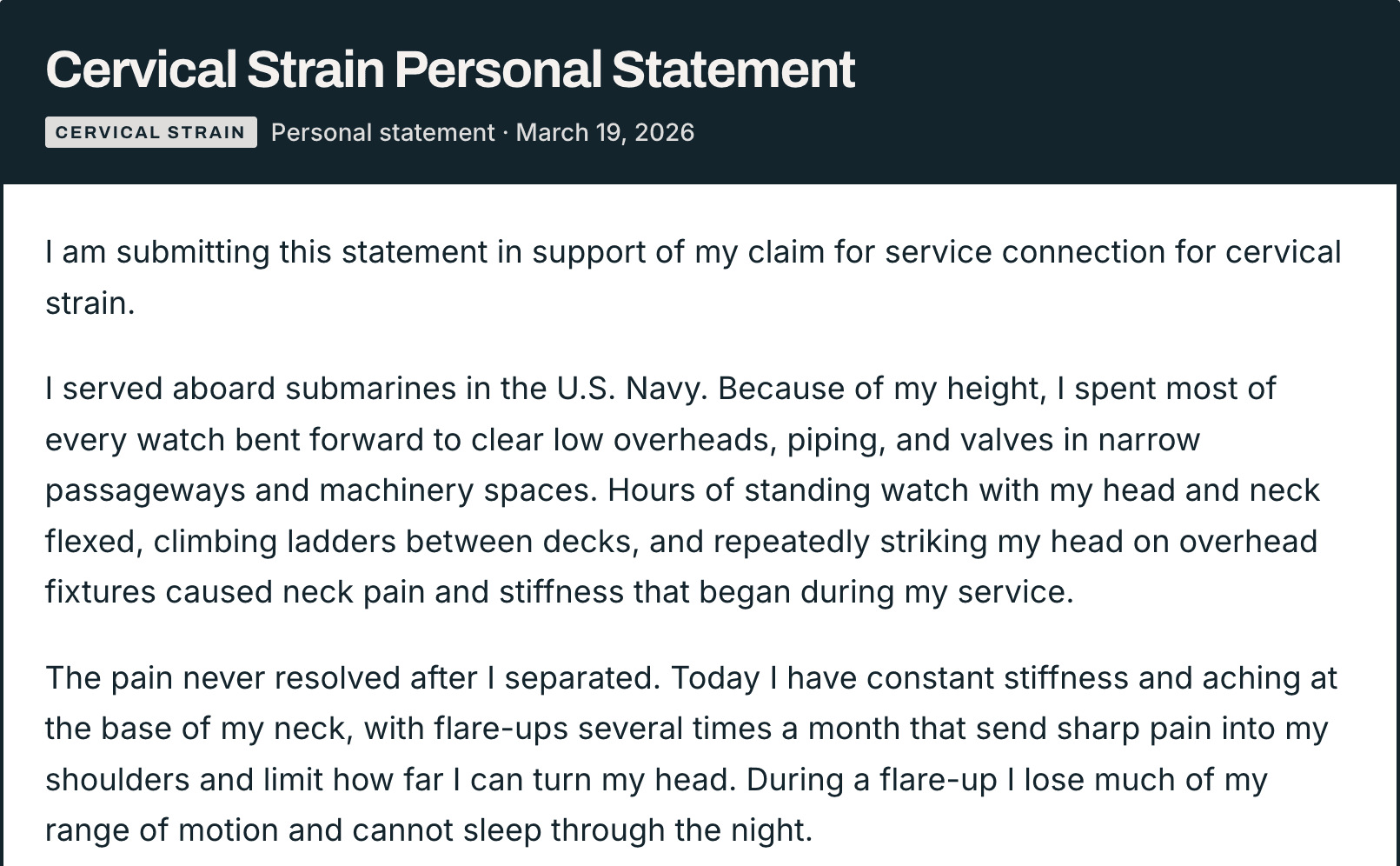
Cervical Strain Personal Statement
Personal statement · March 19, 2026
I served aboard submarines in the U.S. Navy. Because of my height, I spent most of every watch bent forward to clear low overheads, piping, and valves in narrow passageways and machinery spaces. Hours of standing watch with my head and neck flexed, climbing ladders between decks, and repeatedly striking my head on overhead fixtures caused neck pain and stiffness that began during my service.
A statement with your name on it should have your sentences in it.
You’re signing this document. We build it so that what you sign is genuinely what you said — and so you can see every line before you do.
Nothing invented
No symptom, date, event or diagnosis appears in your draft unless you put it there. If you didn’t say it, it isn’t in the document.
Editable to the last line
Every sentence is yours to rewrite or delete before you download. Read it out loud — if it doesn’t sound like you, change it.
You submit it
We never contact the VA, never touch VA systems, and never file anything for you. You download the document and send it in yourself.
Buddy statements: their words
A buddy statement is signed by someone else, so someone else has to write it. We give them the same questions — nobody should ever sign a first-person account they didn’t write and read.
“After trying VeteranAi on my pending VA claim, I became a lifetime member. This program is invaluable for organizing evidence and crafting personal and buddy statements, especially for veterans like us in Germany with limited access to resources.”
U.S. veteran, OCONUS
“Had been sitting at 30% for almost a decade because I didn't think I could claim anything else. I used VeteranAI to identify secondary conditions I didn't even realize were connected. Filed for three secondaries with nexus letters generated through the platform and was granted all three. 30% to 80% just like that.”
30% to 80% in one filing
Reviews are from verified account holders. Read more reviews
You’ll write things here you haven’t told anyone.
Especially on a 21-0781. We treat it accordingly: encrypted at rest and in transit, visible only to you, never sold, never used to train models. Delete your account and every draft goes with it.
- Encrypted at rest and in transit
- Visible only to you — never sold, to anyone
- Never used to train our models
- Delete your account and every draft goes with it
Different documents, different jobs.
A personal statement describes impact. It isn’t a medical opinion and it isn’t a decision — those are other documents entirely. Here’s what each one does.
- Nexus letter
A clinician’s medical opinion
Written and signed by a licensed provider, not by software and not by you. What we can do is help you understand what one needs to contain — including the “at least as likely as not” standard — so you can take the question to your own doctor.
Nexus letter explainer → - C-File
What the VA already holds on you
Your Claims File is your own government record — often thousands of pages — and you’re entitled to it. Reading it shows you what’s already documented before you write a word.
See the C-File Analyzer → - Decision letter
The VA’s written answer
If you’ve already had a decision, the letter says what was granted, denied or deferred and the reason VA gave for each — in regulation language. We translate it.
See the Decision Letter Analyzer →
One price. Try it before you pay.
No plan-picking at signup — every account starts the same way, with full access to every tool. See all plans →
A blank form
Free from VA.gov, and plenty of veterans do it this way. The form isn’t the hard part — the empty box in the middle is.
Cost: your timeClaim sharks
Unaccredited, unaccountable, and paid out of what you were owed all along. The “free consultation” turns into a bill for thousands — or a slice of every month you’re awarded.
Cost: thousands, off your back payVeteranAI
Guided questions, your own words, a draft you edit and sign tonight. Works alongside your accredited VSO — never instead of one.
Cost: $25 / month
- Unlimited personal and buddy statements
- Decision letter and C-File analysis included
- Explainers for nexus opinions and review options
- Six, the AI reference tool, 24/7 all year
Answer the questions, read your draft, and see the whole thing before you’re charged anything. Your card is first charged on day 18 — $25/month if you stay monthly.
- The full statement builder for those 17 days
- Cancel in two clicks — no contract, no collections
Straight answers
Question not here? team@veteranai.coA personal statement (also called a Statement in Support of Claim or VA Form 21-4138) is a written document from you—the veteran—describing how your disability affects your daily life. It covers impacts on work, sleep, relationships, physical activity, and mental health. For PTSD and traumatic event claims, the VA uses VA Form 21-0781. These are among the most important pieces of evidence in your claim because they tell the VA what the medical records alone can't: how you actually live with your condition every day.
No. Unlike a nexus letter, a personal statement comes directly from you and does not require a healthcare provider's signature. It's your firsthand account of how your condition affects your life. You write it (or generate it with VeteranAI), sign it yourself, and submit it with your claim.
A strong personal statement should describe: how your condition affects your daily activities (work, chores, driving, personal care), the severity and frequency of your symptoms, how your condition has changed or worsened over time, the impact on your relationships and social life, any medications or treatments and their side effects, and specific examples of bad days or flare-ups. VeteranAI's questionnaire covers each of these areas so nothing gets missed.
Personal statements are valuable for almost every VA claim type: initial claims, rating increases, supplemental claims after a denial, and secondary condition claims. The VA uses your personal statement to understand the real-world impact of your disability—something that medical records and exam results alone don't always capture.
A personal statement is your own account of how a condition affects your daily life—it comes from you and doesn't need a doctor's signature. A nexus letter is a medical opinion from a licensed healthcare provider that connects your condition to military service using medical evidence. Both are important, but they serve different purposes: the personal statement shows impact, the nexus letter shows causation.
VeteranAI generates your personal statement in minutes. Answer the guided questions about your condition and daily life, and our AI structures it into a VA-ready document you can download immediately.
VA Form 21-4138 is the Statement in Support of Claim — the official VA form for personal statements. It's where you describe in your own words how a disability affects your daily life, work, relationships, and mental health. You don't need a doctor's signature to submit it. VeteranAI's personal statement generator creates a structured statement you can submit as your 21-4138.
VA Form 21-0781 is the Statement in Support of Claim for Service Connection for PTSD. If you're filing a VA disability claim for PTSD, you'll use this form to describe the stressful event(s) that caused your condition — including details about where, when, and what happened during service. VeteranAI helps you structure your PTSD personal statement so it covers what the VA needs to see on the 21-0781.
The VA retired Form 21-0781a and now uses a single form — VA Form 21-0781 — for all PTSD and traumatic event claims, including combat stressors, non-combat stressors, fear of hostile activity, military sexual trauma (MST), personal assault, and harassment. If you previously would have filed a 21-0781a, you now use the updated 21-0781 instead. VeteranAI can help you write a supporting personal statement for your 21-0781 submission.
That's a buddy statement, and it has to be genuinely theirs: a spouse, a battle buddy or a coworker describing what they've seen, in their own words, signed by them. We give them the same guided questions. Nobody should ever sign a first-person account they didn't write and read in full — including you.
No. VeteranAI is self-help software you operate yourself: it asks you questions and organizes your own answers into a document you edit and sign. We are not accredited, we don't represent you, we don't advise you on what to claim or which review option to take, we never contact the VA or touch VA systems on your behalf, and we charge a flat subscription — never a percentage of your benefits or your back pay. Only a VA-accredited representative, agent or attorney can represent you, and accredited VSOs do it free.
You should know all your options. Accredited representatives at organizations like DAV, VFW, the American Legion and your county VSO office help veterans for free, and they can represent you — we can't. Plenty of veterans write their statement here and take it with them to that appointment. Find an accredited rep through the VA.gov accreditation search.
Encrypted at rest and in transit, visible only to you, never sold and never used to train models. Delete your account and every draft goes with it.
A 17-day free trial, then $25/month or $250 a year for the whole toolkit. Cancel any time — no contract, no collections, and no percentage of your back pay, ever. Nobody here is paid out of your award.
Still staring at the blank box?
Answer a few plain questions instead. Read what comes back, change what doesn’t sound like you, and sign it yourself.
Write my statementFree for 17 days · $250 / year after · no cut of your back pay